
Homilies
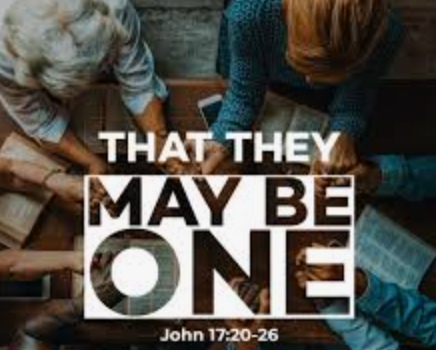
That They May Be One
Holy Spirit take my words and speak to each of us according to our needs.
There is something almost intimate about today’s Gospel, because we are allowed to overhear Jesus praying. Usually, we hear Jesus teaching crowds, answering questions, or telling stories, all before he withdraws to pray alone. But here, in John chapter 17, we are listening at the door while Christ prays.
And what is perhaps most astonishing to hear, is that he is praying for us; Not only for the disciples in the room, or the ones gathered around him, but for those, he says, “who will believe in me through their word.”
That is us. The Church, centuries later, in all its forms.
Jesus is praying for people he has not yet met, but whom he already holds in love. And that matters, because most of us can understand what it feels like to wonder if we truly belong somewhere.
Families demonstrate this well. Families, of course, are rarely simple. Some are close while some are fractured. Some are blended and some are estranged. Some gather around crowded tables whilst others carry the ache of absence, distance, or relationships that have broken under the weight of life. Many of us know that family can be both a place of deep love and deep pain. And yet, even in all that complexity, families are not usually held together because everyone agrees. They are held together because, somehow, they belong to one another. They remain connected not because they think alike, but because love, history, and a shared life have made them so.
John 17 is like that. Jesus is praying God’s family into existence. And even more noticeably, he does not pray that they will all think alike or act the same. He does not pray for perfect agreement. He prays for communion. “That they may all be one.”
It is so easy to hear that and imagine uniformity. Everyone in agreement, comfortable and uncomplicated.
But that is not the unity of the Gospel. Because even the first disciples were not like that. They misunderstood Jesus constantly. They were impulsive, fearful, loyal and even unreliable at times. And yet, still, Jesus loved them.
The prayer of Christ is not for perfect agreement. It is for a love strong enough to survive difference. That feels particularly important for us as Anglicans. Because if there is one thing Anglicans know well, it is how to live with difference. Sometimes we manage it gracefully, sometimes less so. And yet somehow, by grace, we remain at the same table. That is not weakness. It is vocation.
Our Archbishop has spoken of moving forward together by being gracious to differing views. Not by pretending that disagreement does not exist, or demanding that conscience be abandoned, but by learning to remain in relationship even where convictions differ.
That is not easy. But neither is the Gospel. Because Christ does not call us to easy sameness. He calls us to costly communion.
And here there must also be a word of warning, because unity is not the same as denial. It is not about pretending that wounds are not real or remaining silent in the face of injustice and it is not asking some people to disappear so others can feel more comfortable. True unity is deeper than politeness.
In Japan, there is an art called kintsugi, where broken pottery is repaired with gold. The cracks are not hidden; they are honoured. The brokenness becomes part of the beauty.
Wouldn’t it be great if the Church could apply some kintsugi theology? We spend so much of our time and energy trying to pretend there are no cracks. But Christ does something much more alien. He does not erase the fractures, he fills them with grace.
The risen Christ still bears wounds. Unity is not unbroken perfection. It is wounded people held together by love. And that matters when we think about inclusion.
Because inclusion was not our idea first. It was God’s. Jesus did not pray, “Father, let them in once they have made themselves acceptable.” He prays from within a love already given.
Before we succeed, fail or disappoint one another. Before the Church is divided. Jesus prays for us. Belonging precedes behaviour. Grace precedes qualification and prayer precedes policy. That is the good news of the Gospel.
May is a month where many communities will mark Pride events; times of visibility for LGBTQIA+ peoples, many of whom carry deep wounds, either historic or ongoing, from the Church.
And within the Church, people hold different convictions about Pride, about sexuality, blessing, marriage, and theology. Some celebrate joyfully. Some struggle conscientiously. Some, from every side, carry pain. It would be easier if everyone agreed. But they do not. And yet Christ still prays: that they may be one.
That does not mean that personal convictions on either side should disappear but it does mean that love must remain larger than disagreement.
It means we should not begin with suspicion of each other’s motives but with the recognition that every person before us is a beloved child of God.
It means that dignity is not granted by majority approval. It is received from God. It means that graciousness is not a compromise, it is discipleship.
And perhaps this is where faith helps us most.
On the one hand, there are things we can say clearly about God. We can say God is love. God is mercy. God is justice. God is Father, Son, and Holy Spirit. We can say that in Jesus, we see the heart of God made visible.
And we need those truths, because there the Gospel is wonderfully concrete. Jesus does not leave us guessing whether we are loved. He tells us. He shows us. He lives it. He dies for it. “The love with which you have loved me may be in them.”
That is not vague or uncertain. It is spoken, promised, embodied.
But there is also another kind of wisdom in faith: the humility to remember that God is always bigger than our understanding. However much we know, God is more.
God cannot be squeezed neatly into our opinions, our labels, our churchmanship, or our factions. God is greater than our certainty. Sometimes the holiest words we can say are simply: “I may be wrong.” Sometimes the deepest faith is not having all the answers, but standing in reverence before mystery.
And if God is greater than our understanding, then perhaps we should be slower to use our understanding as a weapon against one another.
That kind of humility makes room for grace. Faith says: I know God is love. Humility says: and I do not yet know how vast that love really is. We need both. Without clear faith, we drift into vagueness. Without humility, we harden into pride.
Jesus holds both together. He knows the Father, and yet he still prays in trust. He reveals God’s love, and yet he walks toward mystery.
And then there is this extraordinary line: “The glory that you have given me I have given them.” At first, we might hear the word glory and think of power, success, importance, or always being proved right. But that is not how John’s Gospel understands glory.
In John, glory looks like Jesus kneeling with a towel and a basin, washing his disciples’ feet. It looks like bread broken and shared at the table. It looks, ultimately, like the cross. Glory is not about status. It is about self-giving love. It is love that serves. Love that stays. Love that gives itself for others.
So if Christ says he has given us his glory, he is not giving us triumph over one another. He is giving us the grace to carry one another in love. Not through control or winning arguments, but through compassion and communion.
And that is exactly why we come to the Eucharist. We do not come to this table because we have already managed to become one. We come because Christ is still making us one. We come because grace is given before everything is resolved. We kneel beside people whose views may differ from ours, whose lives we may not fully understand, whose journeys are not the same as our own. And still Christ says: Take, eat. Not because unity is complete, but because unity is being formed.
And perhaps that is the final comfort of this passage. The Church does not begin with our love for God. It begins with God’s love for us; Before we then try and organise it, or defend it, before we divide it, or disappoint it…Christ has already prayed us into communion.
And the bottom line is this: The Father loves us with the same love with which He loves the Son. Not a lesser, probationary or conditional love. The same love. Which sometimes seems impossible to believe but it is the heart of the Gospel.
So perhaps the invitation for us today is simple. To believe that His love is deeper than our fear. To remain at the table. To be gracious where we differ. To honour one another’s dignity. To let the cracks be filled with gold. Because the Church is not held together by our successes or victories, especially those that deny the humility of others. It is held together by the prayer of Christ - for us to Love One Another as he loved us.
Amen.