
Homilies
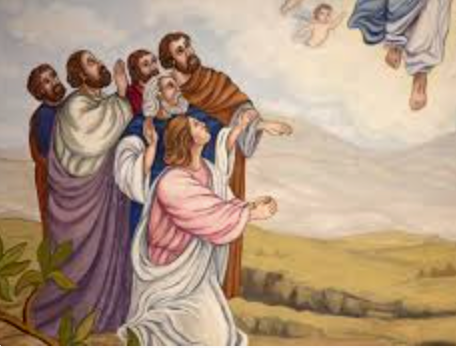
Why Do You Stand Looking Up
Holy Spirit, take my words and speak to each of us according to our need.
Have you ever noticed how there is a slightly awkward moment in the story of the Ascension of Jesus?
Jesus has just been lifted up. The disciples are standing there, gazing into the sky, straining their eyes, trying to hold on to one last glimpse of him. And then, suddenly, two figures appear and say something that feels almost… insulting and if nothing else, abrupt:
“Why do you stand looking up toward heaven?”
Its subtlety may mean it being missed as a gentle rebuke. But it is, most definitely, a turning point.
If we’re honest with ourselves, we can completely understand the disciples’ behaviour. They’ve lost Jesus once before. They watched him be tortured and die. Then, astonishingly, they met him again after the resurrection. And now, just as they begin to settle into this new reality, he is gone, again.
So of course they look up. Of course they linger. Of course they want to stay in that moment for as long as possible. Because looking up is easier than moving on.
And yet, in the opening of the Acts of the Apostles, they are told: “don’t stay here.”
They aren’t told this because what just happened didn’t matter. But rather, because it mattered so much that it changes what happens next.
And perhaps that’s the part we often miss. The Ascension is not the end of the story. It is the moment the responsibility shifts. It is the moment when the disciples realise that following Jesus will now mean embodying what they have seen and heard and that they learned from him.
Now, we might not literally stand staring upwards at the sky, but we do all have our own versions of it.
We ‘look up’ when we are: Waiting for certainty before acting. Holding onto the past instead of stepping into the present. Wishing and waiting for God to “fix things” without asking what part we are called to play in it.
We are caught looking up when our faith becomes passive; when it turns into watching and waiting, rather than active participation.
We might even try to justify it. We can call it patience, or discernment, or caution. And sometimes it might be those things. But also sometimes, if we are honest, it is hesitation. It is fear. It is the quiet hope that the situation may change or disappear or that someone else will step forward instead.
And so, the same question should be put to us just as it was to the disciples: ‘Why are you still looking up?’
History, both ancient and modern, gives us glimpses of what happens when people stop looking up and start stepping forward.
Think of William Wilberforce, who refused to accept injustice as inevitable, and laboured on patiently and persistently because he believed Christ’s reign demanded something different of the world. Or Florence Nightingale, who saw suffering and stepped toward it rather than away from it.
More recently, consider Fr. Mychal Judge, the New York fire department chaplain who, on September 11th, did not stand back in fear but walked into chaos to pray, to comfort, to be present and who ultimately lost his life in doing so. He did not wait for certainty. He responded with love.
Or Carlo Acutis, a British born saint, who sadly died from leukaemia at the age of 15 in 2006 but who, having lived an ordinary life in many ways, chose daily faithfulness, using his gifts, his time, his energy to point others toward Christ. Not dramatic, not grand, but steady, intentional, real.
Or a little closer to home, Aneurin Bevan, who saw the suffering caused by lack of healthcare and did not accept it as unchangeable. He acted, helping to establish the NHS, knowingly not perfectly, and not without opposition but nevertheless with a conviction that people deserved dignity and care.
None of these people were without flaw. None of them had complete certainty. But each, in their own way, stopped standing still. Each chose to act in the world as it was, because they believed it could reflect more of God.
Because here is the surprising truth: The Ascension is not actually about Jesus disappearing at all…It is about Jesus reigning.
As Ephesians tells us, Christ is raised and seated “far above all rule and authority and power.” This is not absence, it is authority. Not distance, but instead a different kind of presence. Which means the world is not left empty.
It is, in fact, under new leadership. And that changes everything.
It changes how we see power. It changes how we see suffering. And it should change how we see our own, ordinary lives.
It means that no act of compassion is wasted. No quiet faithfulness is unseen. No small step of courage is insignificant. For the disciples, the ascension marked a significant shift. They were no longer just followers walking behind Jesus. They were witnesses. And participants. They became a people entrusted with a story that now had to be lived out, and not just observed.
And the same is true for us.
The Ascension draws a line in the sand: From watching → to witnessing From waiting → to acting From holding on → to being sent
Alongside this, we might also consider the words often attributed to Teresa of Ávila:
“Christ has no body now on earth but yours; no hands but yours; no feet but yours…”
In other words, we are now the means by which Christ’s presence is made known.
So what does this look like for us, not in theory, but in actual daily life? It means recognising that faith is not something we have, but is something we do. It is something we step into, not just keep hold of.
That might look like: Choosing to show compassion when it would be easier to withdraw from the situation. Speaking out with the truth when remaining silent would feel safer. Offering our presence to someone who is struggling whilst they are in the midst of it, instead of waiting for the “right moment” which may never appear.
It might look like advocating quietly but persistently for those whose voices are not heard. It might look like refusing to give in to cynicism when hope feels fragile. It might look like continuing to love when loving is costly.
Because if Christ reigns, then every ordinary moment becomes a place where that reign can be made visible.
We may worry about our abilities, about not having the right words or knowing how to behave. But the call is not to offer perfection. The call is to act with integrity and generosity, and with trust in Jesus.
Knowing we do not do this alone. The same story that tells of the Ascension also points us toward the gift of the Spirit, God’s presence with us, in us, working through us in ways we may not always see or understand.
Before I finish, let me offer, if I may, three simple invitations for when we leave here and the week ahead; a way to hear, something to meditate on, and a way to act.
Firstly, try to take some time to notice where you might be “looking up”—waiting, hesitating, or holding back.
What is being asked of you that you might have been postponing? What nudge have you been quietly ignoring?
Secondly, sit with this for a while: Christ is not absent.
Even when life feels uncertain, or heavy, or unclear, Christ is still present, and Christ still reigns.
Take some time to let that settle, into your head and your heart. How might this change of perspective affect you? What would it mean to live knowing that this was truly real?
Lastly, try taking one small, decisive, active step this week.
It needn’t be something dramatic. But something faithful and genuine. Perhaps, A conversation An act of kindness A decision to show up where you might otherwise hesitate.
Because, ultimately, the call of the Ascension is not to do everything. It is simply to stop standing still. To actively take on being and doing, in the name of Jesus.
One Final Thought…
The disciples did not stay looking at the sky. They returned to the city. They prayed. They waited, but now with purpose. And soon, they would begin to speak and act in ways that changed the world. Not because they had all the answers. But because they trusted that Christ was already at work.
And perhaps that is the quiet thread that runs through all these lives from those first disciples, through the saints of history, and to those more recent witnesses we named… They did not wait until everything was clear. They trusted enough to begin.
And that is the invitation before us.
Not to have everything figured out. Not to be certain of every step. But to trust enough to begin.
And so, the question comes to us again, not as a criticism, but as an invitation: ‘Why are we still looking up?’
Go. Live. Witness.
For Christ is not gone. Christ reigns, supreme.
Amen.