
Homilies
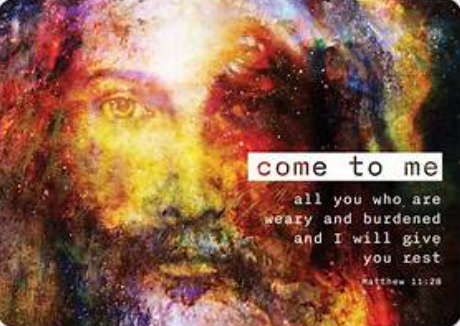
Come to me, all who are weary.
Holy Spirit, take my words and speak to each of us according to our need. Amen.
"Come to me, all you who are weary and are carrying heavy burdens, and I will give you rest."
I wonder how many of us needed to hear those words today. Not next week when life is a little less busy. Not when everything has been sorted out. But today. Because if we're honest, life is exhausting and most of us know something about that kind of weariness.
Some of us are physically tired. We work hard all through our lives. We are caring for children, grandchildren, ageing parents or partner. Some live every day with pain or illness. Some simply find that life moves faster than it used to, and it’s a struggle to keep up.
Others are emotionally weary. Perhaps we're carrying grief or we're anxious about the future. Maybe we're worried about someone we love. Perhaps we've become tired of bad news, conflict, uncertainty, or of wondering what tomorrow will bring.
And then there is another kind of weariness. The weariness that comes from carrying things that nobody else can see. The burden of trying to live up to other people's expectations or pretending that everything is alright. Wondering whether we are really enough. Many people carry that burden for a variety of reasons.
It may be a young person who feels different and quietly wonders where they belong or it could be someone who practices every conversation before they speak because they are afraid that if people knew the whole story of their life, they might not be accepted. Perhaps it is someone who has spent years carrying the wounds left by rejection, misunderstanding or exclusion. Or it may simply be the burden of always trying to be strong. Always coping. Always smiling. Never letting anyone know just how heavy life has become.
Those burdens are often invisible. We cannot always see them as we met people. We smile. We shake hands. We ask, "How are you?" And so often the answer given, is the expected one, "I'm fine."
But God knows the truth. God always knows. And into all of that. Jesus says, "Come to me." Notice what he does not say. He doesn't say, "Come back when you've sorted your life out." or "Come when your faith is stronger." Or even "Come when you've got all the answers." He simply says, "Come."
That is the Gospel. God always meets us where we are now, not where we think we ought to be. He welcomes us with our questions, our doubts, our failures, our hopes, our fears and with all the pieces of ourselves that we would rather keep hidden.
And that, surely, is where real freedom begins. Freedom doesn't come from pretending. Freedom begins with coming honestly to Christ.
Here in Wales, we have a wonderful gift in our language that helps us understand what Jesus is offering. In Welsh there is more than one word for peace. Firstly, there is heddwch. That is the peace of quietness. Of sitting in the garden after a busy day or walking beside the sea. The peace of switching off the television and just hearing the silence.
It is such an important word that it lies at the root of the word Heddlu, our police force, it literally means a force whose purpose it is to keep the peace.
We all need a little more heddwch. Life is noisy. Phones buzz. News never stops. Emails keep arriving. There is always another demand on our attention and we can often find ourselves longing for a little quiet.
But there is also another Welsh word for peace. Tangnefedd. And I think that it is this peace Jesus is talking about today. Because tangnefedd is something much deeper. It is peace in the soul. God's peace. The peace that remains even when life itself is not peaceful.
Jesus never promises us an easy life. He never says that if we follow him nothing bad will ever happen or that illnesses will disappear. He doesn't promise that relationships will never be difficult or that grief will never visit us. And he doesn't promise that everyone will understand us or agree with us.
Instead, he promises himself. Because circumstances come and go. But Christ remains. He says, "I will give you rest." Not simply rest for our bodies. But rest for our souls.
The rest that comes from knowing we are loved before we achieve anything, from knowing we don't have to earn God's approval, from knowing that before we belong anywhere else, we belong to Christ.
But then Jesus says something rather surprising. "Take my yoke upon you." At first that sounds odd. If we're already tired, why would he ask us to carry a yoke?
But remember what a yoke is. It’s a beam that joined two animals together so they could share the burden of the work to be done. Jesus is not piling on another burden. He is saying, "Walk with me." "Let me carry this with you."
The burdens the world gives us are very demanding. The world says, you are what you achieve. You are what you earn. You are what other people think of you. You need more. You should be better. You must keep proving and improving yourself. No wonder people are exhausted.
But Jesus offers us something completely different. He says "You are already loved." "You are already mine." "You are already welcome." His yoke is not the burden of impossible expectations. It is the freedom of grace.
It’s one of the greatest paradoxes of the Christian faith. The world tells us freedom comes from making our own rules and choices. But, Jesus tells us freedom comes from walking in God's ways. At first, that sounds strange. Until we think about it further.
A train is most free and capable when it stays on the rails it was made for. A fish is most free in the water. A bird is most free in the sky. And human beings are most free when we live as God created us to live. Gods commandments are not there to make life smaller. They are there to make life fuller. God’s ways are not chains. They are a path to freedom. The freedom to stop pretending, to forgive, to love, to become the people God always intended us to be. Like the banks of a river offer a structure within which the river can flow strongly and freely.
Think of two people carrying a heavy piece of furniture together. The weight hasn't disappeared. But it becomes possible to move it because it is shared. That is what Christ does. We no longer have to carry our burdens alone. If we look back over our lives, many of us can probably think of moments when we wondered how we ever kept going. And yet somehow we did. Perhaps only now can we realise that Christ had been carrying far more of the weight than we ever knew.
That is tangnefedd. Not the absence of storms. But the presence of Christ in the middle of them. And as the Church, that is also our calling. If Jesus says, "Come to me," then the Church should never put barriers where Christ has opened the door.
Our churches should be places where weary people find welcome. Where questions are safe. Where burdens can be shared. Where forgiveness is freely given. Where people discover not condemnation, but grace.
Because every one of us comes here in need of grace and mercy. None of us has arrived. We are all still learning. We are all still growing.
So today, hear those words once more. Not as words spoken to a crowd two thousand years ago. Hear them today as words spoken directly to you.
Whatever burden you may have carried in through these doors this morning, whatever sorrow, anxiety, disappointment, questions, whatever hidden weariness...
Jesus says to you, "Come to me." Come just as you are. Bring your questions, your failures, your hopes, your whole self and receive not only heddwch (that precious quietness we all long for) but also tangnefedd.
The deep peace of Christ. The peace of being fully known, being completely loved, of knowing that nothing not failure, fear, grief, rejection, or even death itself can separate us from the love of God.
That is true freedom. Freedom in Christ. For his ways lead us into life. His ways lead us into peace and his ways always lead us home. Amen.