
Homilies
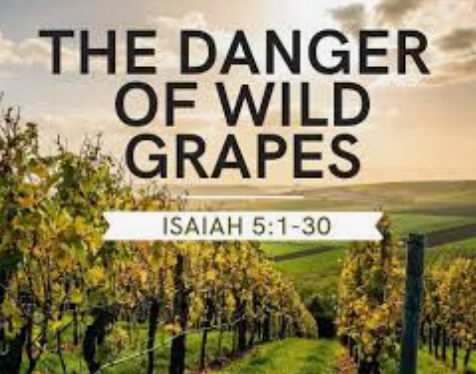
Wild Grapes from the Vineyard
Holy Spirit take my words and speak to each of us according to our need.
Today’s gospel began rather beautifully. A landowner planting a vineyard, putting a wall around it, digging in a winepress, building a watchtower; everything is prepared with precision. It is a reference to Isaiah’s picture of God’s loving care for Israel: “He dug it and cleared it of stones, and planted it with choice vines.” And Jesus’ listeners would have know that Isaiah scripture well.
God has planted. God has nurtured. God has entrusted. And then it goes wrong. The tenants begin to behave as though the vineyard belongs to them.
That is where both Isaiah and Matthew meet and where it begins to speak directly to us as well. Because the problem isn't that God’s vineyard is bad. The problem is that those entrusted with it have forgotten that they are tenants, not the owners. They have confused stewardship with possession.
This might be one of the greatest temptations within our faith. We begin by receiving something wonderful from God; a faith, a tradition, a church, a community, a vocation and gradually we start behaving as though it belongs to us. We can begin to think: This is our church. These are our people. This is how we do things. These are the people who belong here. And then Jesus comes along and prompts us with a rather awkward question: Where is the fruit?
Because, you see, in both Isaiah and Matthew, fruitfulness is what matters. Not pedigree, status, nationality or ethnicity. Not who has been here the longest or who knows the rules best.
Just fruit or rather fruitfulness. Jesus says that the kingdom of God will be given to a people who will “produce the fruits of the kingdom.”
That is a remarkable thing to say because the argument is now no longer primarily about who is in and who is out. It is about whether the vineyard produces the fruit that God desires. And that is important because Matthew's Gospel will eventually take us beyond the boundaries of the nation of Israel to the command of the risen Christ to “Go therefore and make disciples of all nations.” The mission of God is bigger than any one group of people.
But this isn't because God has suddenly changed his mind about Israel. God hasn't become a different God. The God who planted the vineyard in Isaiah is the same God who sends his Son in Matthew. The God whose love begins in one particular people turns out to have a love that is large enough for all peoples. That is not God abandoning his promises. It is God revealing just how much bigger his promises are than we could have imagined.
And that is something we need to hear today. We live in a world where people are constantly being divided into us and them. People are labelled by where they come from, what they believe, how they look, what language they speak, how they worship, whether they are rich or poor, whether they are disabled or able-bodied, whether they fit comfortably into our expectations.
And yet there are also signs of people beginning to refuse to live that way.
This month, more than a hundred mosques across Britain have opened their doors through the “Visit My Mosque” initiative — offering food, conversation, art and opportunities for people to meet one another rather than simply rely on stereotypes.
Here in Wales, the Church is also trying to ask what genuine inclusion looks like. The Church in Wales has begun work on a Disability Welcome Delivery Group, deliberately seeking the voices and lived experience of disabled and neurodivergent people in shaping the Church's future. These are limited examples, perhaps. But they point towards something important. The vineyard produces fruit when people stop asking, “Who belongs to us?” and start asking, “What does God need us to grow?”
That changes the focus completely. And it changes the Church. Because the Church is not our possession. The Gospel is not our possession. Even our traditions, as precious as they are, are not ours to lock away and guard as though we were the owners.
We are tenants. Stewards. People entrusted with something we did not create and do not ultimately have control of. Which is actually rather good news. Because if the vineyard is God's, then we don't have to carry the whole thing on our shoulders. We are accountable, but not ultimately responsible.
God is still the gardener. God is still planting. God is still nurturing. God is still bringing people into the vineyard whom we might never have expected. And God is still looking for fruit.
So what does that fruit look like? St Paul gives us one answer: love, joy, peace, patience, kindness, generosity, faithfulness, gentleness and self-control. In other words, the fruit of the kingdom is not just about having the right people in the right places.
It is about becoming the kind of people through whom God's love becomes visible. A church can be small in number and still bear enormous fruit. A person who has little influence can transform another person's life through kindness. A conversation over coffee can dismantle years of suspicion. A genuine welcome can tell someone who has felt excluded that they are not invisible. A community can share what it has rather than guarding it. That is fruit.
And the challenge of this parable for all of us is “How do we faithfully steward what God has entrusted to us?”
But there is hope, because the final word of the parable is not the violence of the tenants. It is the stone they rejected: “The stone that the builders rejected has become the cornerstone.” The Son was rejected, but God was not defeated.
Humans keep trying to possess the vineyard, but God's purposes continue. We close doors; God opens them. We draw boundaries; God widens the circle. We think we know who belongs; God keeps surprising us.
And at the heart of all that is the good news that God has not changed. The God who planted the vineyard still loves the vineyard. The God who called Israel still keeps faith. The God who sent the Son still sends his people.
And the God whose love was revealed first through one particular people has always intended that love to overflow to the whole world.
So today let’s accept Jesus’ invitation to look around our own little patch of vineyard. What has God entrusted to us? And what fruit is growing there? Where are we tempted to say, “This belongs to us”, when God is saying, “I have entrusted this to you”?
One final thought, where might God be asking us to make the vineyard larger; more welcoming, more generous, more open, more fruitful?
Because in the end, the vineyard still belongs to God. We are only its stewards, but the wonderful thing about being God's stewards is that we don't have to manufacture the fruit by ourselves. We simply need to make room for the gardener. And then, we may just discover that the vineyard is far larger, and the harvest far more abundant, than we ever could have imagined.
Amen