
Homilies
Harvest 2026
Holy Spirit, take my words and speak to each of us according to our need. Amen.
There is something quite comforting and lovely about a Harvest Thanksgiving service. We decorate our churches with fruit and vegetables, flowers, tins of food, perhaps a loaf of bread or two. We sing harvest hymns, we give thanks, and we are reminded of something which is very easy to forget: We are not alone, we depend on other people.
We depend on farmers and growers, shop workers and delivery drivers, people who work in food production and transport. We depend on rain and sunshine, healthy soil and clean water. We depend on bees pollinating flowers and worms enriching the soil. And, ultimately, we depend upon God.
Harvest has traditionally been a time not just to say thank you, but also to recognise our dependence upon God and upon one another. There is an old tradition associated with this which you may have heard of: Rogation. The word comes from the Latin rogare, meaning “to ask.”
Traditionally, communities would walk around the boundaries of their parish, praying for God’s blessing upon the land, the crops, the animals and the people who worked them. They were asking God for rain and sunshine, for healthy crops and good harvests. But they were also giving thanks for what had already been provided.
That gives us a helpful way of thinking about how we celebrate Harvest. We ask. We receive. We give thanks.
And then …. Well, what we are going to do with what we have received?
And that last part matters because of our Gospel reading today when Jesus encountered someone who wanted to know what he must do to inherit eternal life.
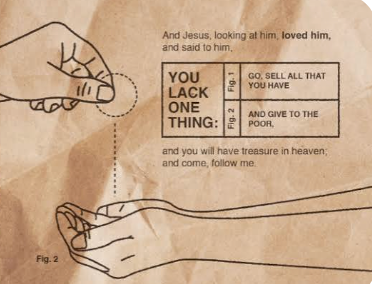
It sounds like a straightforward question. But Jesus begins to challenge him about the way he lives. The man tells Jesus that he has kept the commandments. He has lived a good life. He has done the things he believes he is supposed to do. And then Jesus looks at him and says: “You lack one thing; go, sell what you own, and give the money to the poor.” And we are told that the man goes away shocked and grieving, because he has many possessions.
It is a difficult Gospel reading. And I think it would be easy to hear it simply as a sermon about money. But perhaps Jesus is asking a deeper question: What is it that we rely on to make us feel secure? Because possessions aren't necessarily the problem. Money can provide security. A home provides shelter. A savings account can give us peace of mind. A car gets us where we need to go. Our possessions can be useful, and meaningful.
The question Jesus asks is: Do we possess our possessions, or do our possessions possess us? And Harvest gives us a surprisingly good way into that question. Because we live in a society where it is very easy to forget where things come from.
Ask a child where the milk for the breakfast cereal comes from or where the bread for the toast comes from, not to mention the eggs and you might get the answer: “The supermarket.” technically, they're right! But the supermarket isn't where breakfast begins.
The bread began as grain growing in a field. The milk came from cows. The eggs came from chickens. And behind every one of those things are people: farmers, growers, pickers, packers, drivers, warehouse workers, shop workers. And behind all of that are the gifts of creation itself: soil, water, sunlight, rain, seasons and life.
Harvest reminds us that the things we take for granted are actually gifts. And once we recognise something as a gift, it changes the way we look at it.
Think about you first cup of tea or coffee in the morning. We can simply drink it. Or, for just a moment, we can think: This is a gift. Someone grew the tea or coffee. Someone harvested it, then processed it, transported it, stocked it on a shelf to be sold. And now it is sitting in my hands. And through all of that, God has provided. That little cup of tea becomes an opportunity for gratitude.
And that's part of what Jesus is getting at. The danger isn't in having things. The danger is in forgetting that everything we have is ultimately gift. Because when we forget that, it becomes very easy to move from gratitude to entitlement. Or from saying: “Thank you for what I have,” to thinking: “I deserve to have more.”
The other readings today also link through this into Harvest. The writer of Hebrews reminds us that the word of God is living and active. It reaches beneath the surface of our lives and sees what is really going on in our hearts. And Harvest does something similar.
It looks beautiful on the surface; flowers, fruit, vegetables, bread. But underneath it asks some uncomfortable questions. How much is enough? What do I really need? What do I do with what I have? Who goes without so that I can have more?
And most importantly: What do I look to to find my security? Because we can put our security in all sorts of things. Money. Possessions. Our home. Our job. Our reputation. Our achievements. Even our ability to be independent. But none of those things is ultimately secure.
The rich man in the Gospel discovers that. He has done everything right, and yet there is still something missing. Jesus isn't simply asking him to give up his possessions. He is asking him to discover that his possessions cannot save him. Only God can do that.
That is a challenging message for all of us. Because we live in a culture which constantly tells us that we need more. A newer phone. A bigger television. A better car. A bigger house. Another holiday. Another subscription. Another thing that will make life easier, happier or more complete. And the advertising industry is remarkably good at telling us that whatever we have, there is something else we need.
Harvest offers a different message. Look at what you already have. Look at the food on the table. Look at the people around you. Look at the beauty of creation. Look at the community in which you live. Look at the gifts and abilities God has given you. And say: “Thank you.” But Harvest doesn't stop at gratitude. Because if everything is gift, then we are also called to become givers. That is why our Harvest collections are so important. When we give food to a food bank, we are doing more than filling a food parcel. We are saying to someone who is struggling: “You matter. You are not forgotten. You belong to this community.”
When we support a local charity, we are recognising that what we have can become a blessing for somebody else. When we share food with a neighbour, buy from a local producer, grow something ourselves, compost rather than throw away, repair rather than replace, or simply make sure that good food doesn't end up in the bin, we are practising gratitude.
And although these things may seem small, Christianity has always been rather good at small things. A mustard seed. A few loaves and some fish. A little bread and wine… God takes ordinary things and uses them to bring extraordinary blessing.
So the challenge for us this Harvest is not to think. “How much do I have?” but: “How much can I share?” Not: “What else do I need?” but: “What do I already have that could bless someone else?”
And that also has implications about the way we care for God's creation too. We know that our world is under pressure. We see it in extreme weather, flooding, drought, changing growing seasons and the pressures facing farmers and food producers. We see it in the amount of food that is wasted and the enormous amount of packaging that we throw away. We see it when natural habitats disappear and species struggle to survive. And we don't have to become experts in climate change or environmental sciences to recognise that Creation is God's gift, not our possession.
We have received it. And therefore we have a responsibility to care for it. Each of us can ask: What can I do with what God has entrusted to me?
That may be trying to waste a little less food or buy local. Perhaps we could grow something or mend rather than replace it.
We could simply become more intentionally grateful for the food we eat and the world in which we live. Small things matter. Because Christian discipleship is very often about what we do with ordinary things, every ordinary day. Harvest today, can give us a new pattern to live by.
Receive. The gifts of God Give thanks. For all of them Share. The gifts with others Care. For the world from which they came
The next time you spread butter on your toast, bite into an apple, pour milk into your tea or make dinner, stop for just a moment. And say: “Thank you, Lord.”
And then perhaps ask one more question: “How can this gift become a blessing for someone else?” Because that is the challenge hidden within the Gospel today. Jesus isn't asking us simply to give things up. He is inviting us to discover a different way of living. A life where we are not controlled by what we own. A life where we don't constantly need more. A life where we can receive God's gifts with gratitude, share them generously for others.
Amen