
Homilies
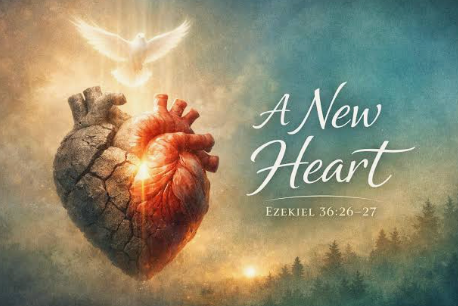
A New Heart and A New Spirit
Holy Spirit take my words and speak to each of us according to our need.
“Get yourselves a new heart and a new spirit… Turn, then, and live.” There is a hopeful quality about those words. And yet, they can also sound rather daunting.
“Get yourselves a new heart.” Well, how exactly do we do that? If only changing ourselves were as easy as changing the battery in the remote. Perhaps life would be a little simpler. But the heart of Ezekiel's message isn't really, “Try harder and become a better person.”
Ezekiel is speaking to people who have experienced catastrophe. Jerusalem has fallen. The people have been defeated and taken into exile. Their homes have been lost. Their community has been shattered. And, understandably, they are looking backwards. They are asking who was to blame.
There is a saying set within the chapter which seems to try and give a reason: “The parents have eaten sour grapes, and the children’s teeth are set on edge.” In other words they believe they are are suffering because of what other people have done before them.
And there is some truth in that. Our lives are affected by the decisions of those who came before us. Families carry patterns from one generation to another. Communities can inherit poverty, trauma, prejudice and broken relationships. We don't all begin life from the same starting point.
Ezekiel isn't denying any of that. But he refuses to allow the past to have the final word. He won’t let them sit back and avoid any responsibility because of it. His message is essentially this: What has happened to you matters. What has happened before you matters. But it does not have to determine what happens next.
That is an extraordinarily hopeful message and in today’s language may been seen as an invitation to break the cycle, because we all carry things from the past.
It may be something we regret or something somebody did to us. Perhaps it is a habit we have developed over many years or a relationship that has gone wrong. It might be something we said which we wish we could take back. Or it could be the story we have told ourselves about who we are: “I've always been like this.” “My family are like this.” “I'll never change.” “It's too late for me.”
Ezekiel say it isn't too late. “Get yourselves a new heart and a new spirit.” He isn't telling people to pretend that the past never happened. Repentance isn't denial, it begins with honesty. It is being able to say: This is where I am. This is what has happened. This is what I have done. This is where I have gone wrong. But then comes the also: I don't have to stay here.
A simple illustration of this can be found on a sat-nav. You may have heard that slightly irritating moment when the sat-nav announces “Recalculating.” When you've missed the turning.
We may have been distracted or concentrating on something else or simply not paying attention. Or if you’re anything like me, then you’re still thinking ‘I don’t know how far 300 metres is’
But the sat-nav doesn't say: “You absolute chump. You've ruined the journey. You might as well give up.” It just says: “Recalculating.” And it finds another route.
Could this be a metaphor for our faith life too? Sometimes we take a wrong turning, mess of things or hurt other people or ourselves. But the message is not that God stands shouting, “You should have known better.” It is that God says: “Turn around. There is another way.”
That is what repentance means. The word repentance literally carries the sense of turning around, of changing direction. And that is what Ezekiel is inviting his hearers to do.
Not to feel guilty or beat themselves up. Not to become anxious about whether they are good enough.
But to turn, because the remarkable thing about this passage is where Ezekiel ends up. He doesn't end with condemnation. He doesn't say, “You deserve everything you've got.” He says: “Why will you die, O house of Israel? For I have no pleasure in the death of anyone, says the Lord God. Turn, then, and live.”
Turn, then, and live. God's motivation is not revenge. God isn't interested in human beings destroying themselves. God doesn't take pleasure in watching people fail.
In effect Israel is being told “Why stay on a road that leads to death when there is another way?” And that makes these ancient words relevant to us as well. Because our world has changed enormously since Ezekiel's time. We have smartphones and artificial intelligence, satellites and social media. We can communicate instantly across the world. But, human beings haven't changed quite as much as we sometimes imagine.
We still make mistakes. We still blame other people. We still carry wounds. We still struggle to change. We still get stuck in patterns. We still long for forgiveness. And we still wonder whether we can begin again.
Think about someone who finally decides to seek help for an addiction. Or someone who realises that their anger is damaging their family and decides to do something about it. Or somebody who has spent years believing, “I'm no good at this,” and finally gives themselves permission to learn. Or somebody who has been estranged from a family member for years and finally picks up the telephone and says, “Can we talk?”
None of those things magically erase the past. But they can change the direction of the future. Sometimes the turning point begins with something remarkably small: May be an apology, a conversation, a decision. But almost indefinitely with a willingness. That can be the beginning of a new heart.
Ezekiel says: “Get yourselves a new heart and a new spirit.” But later in Ezekiel, God makes an even more remarkable promise: “I will give you a new heart, and put a new spirit within you.” And there is the mystery of Christian transformation.
We are called to respond, called to turn, called to make different choices. But we are not expected to transform ourselves entirely by our own strength. The Christian life is both our response and God's grace. We turn towards God, and discover that God has already been turning towards us. We take one step and discover that grace has been waiting for us.
That is why the language of a “new heart” is so powerful. It goes deeper. It is about what is happening inside us. Our desires, priorities and relationships. The way we see ourselves. The way we see other people. And the way we see God.
Ezekiel's words remain important. Because sometimes what we need isn't a new set of rules, it’s a new way of seeing and living. A new direction. A new heart.
Some of us here today may need to hear: You are not trapped by your past. You are not defined by your worst mistake. The things that have happened to you do not have to determine the whole of your future. Some may need to hear: It is not too late to change direction.
And some just need to hear the words that God speaks through Ezekiel: “I have no pleasure in the death of anyone.” God wants life. Not merely existence. Not simply getting through the week. Not living under the weight of guilt or regret. But life, freely, generously, compassionately, and deeply rooted in God's love.
“Get yourselves a new heart and a new spirit.”
So I’m going to challenge myself this coming week and ask God: What needs to change in me? What am I holding onto that I need to let go of? What direction am I travelling in?
Is there a turning I have been avoiding? The good news is that we don't have to know the whole journey. We only need to take the next turning. Because if or when we get it wrong, God doesn't abandon us.
There is always the possibility of recalculating, always the possibility of turning and always the possibility of grace.
So the final word of Ezekiel isn't condemnation. It is invitation to life in its fullest. “Turn, then, and live.”
Amen.