
Homilies
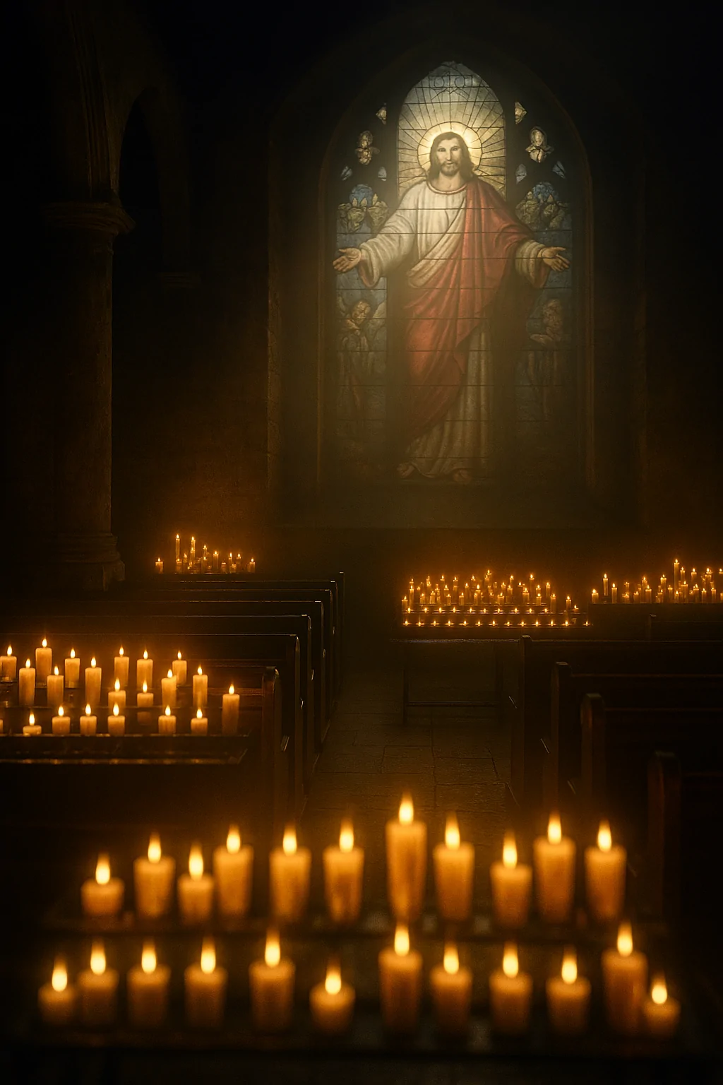
All Souls - The completion of God's promise
Holy Spirit, take my words and speak to each of us according to our need.
Today we commemorate All Souls’ Day, the feast of continuing hope. It’s a day that reminds us that God’s love doesn’t stop at death. His mercy doesn’t have an expiry date, and what He starts in us, He finishes; gently, patiently, and completely.
Hope rather than sadness is the heartbeat of today.
We remember those who have gone before us, not as people lost to the past or kept alive only in memory, but as lives still held in God’s love. They are part of a story that’s still unfolding, one that includes everyone: those who came before us, those who will come after, and us, here and now.
That’s why All Souls’ Day isn’t simply about remembering those who have died, it’s about remembering who God is: a God who continues His work of love long after our earthly story ends.
In his letter to the Thessalonians, Paul says, “May God make you worthy of His call.” That’s another way of saying: God isn’t done with us yet. We’re all works in progress; learning, healing, and growing into the people we were made to be.
And that same hope extends to both those who have died and those who are yet to come.
All Souls’ Day isn’t about fear or loss; it’s about trust. Trusting that love continues its work even when we can’t see how. As one writer put it, “Love is strong as death — and stronger still, because it endures beyond it.”
That’s what gives this day its quiet strength. Even when our hearts ache, even when grief lingers, we hold onto the truth that love endures, and that the God who began a good work in us will bring it to completion.
Jesus said, “The Son of Man came to seek and to save the lost.” That’s what He did for Zacchaeus, a man who had success but no peace, wealth but no joy. He climbed a tree just to catch a glimpse of something real.
And Jesus saw him. He looked up and said, “Come down. I want to stay at your house today.”
And that’s the kind of God we have. One who notices us when no one else does. He meets us in our curiosity, our longing, our small acts of reaching out. And when He calls us down from our trees, our hiding places, our pride, our fear it’s not to scold us, but to share a meal, to bring us home.
All Souls’ Day reminds us that this same love reaches beyond time and space. God still seeks, still saves, still welcomes. No one is beyond His reach; not Zacchaeus, not those we’ve lost, and not us.
Isaiah speaks for God when he says, “Though your sins are like scarlet, they shall be as white as snow.” That’s not about judgment; it’s about healing.
When we bring our mess and mistakes to God, He doesn’t condemn us — He restores us.
We live in a world that can be harsh and unforgiving, where people are often defined by their failures or frozen in the worst moment of their story. But God’s way is different. He cleanses, renews, and gives new beginnings; both in this life and beyond it.
Archbishop Desmond Tutu once said, “God’s forgiveness is not earned by our success, but given because of our need.” And that’s the hope we rest in today. Not that we are perfect, but that we are loved perfectly.
My children used to ask me whether Heaven was just for good people. It wasn’t until they were a little older that they understood my reply: “Heaven is full of people who weren’t perfect, but said sorry and meant it, so they were forgiven.”
That’s the Gospel in its simplest form — grace for those who admit they need it. And that same grace holds the souls we remember today.
Psalm 32 says, “Happy are those whose transgressions are forgiven.” There’s a peace that comes from being known and still loved. And there’s peace in remembering that those we’ve lost are safe in that same love, free from pain, forgiven, and whole.
In a world that often cancels rather than forgives, All Souls’ Day reminds us of a better way — a grace that pursues and never gives up. If God’s love continues beyond death, it certainly continues through life.
Today we can honour all those we’ve lost by living with the same hope they now know fully. That means noticing the people around us, the ones who feel unseen like Zacchaeus in his tree, and offering kindness, presence, and forgiveness.
It’s about making space for mercy in our homes, in our conversations, and even in how we see ourselves.
Because when we live as people of hope, we reflect the God who never stops reaching out.
Every act of compassion, every prayer whispered for another, every moment of mercy are glimpses of heaven already breaking into our world.
So let us take heart:
The God who sought Zacchaeus seeks us still.
The Christ who dined with sinners still welcomes all souls home.
And the Spirit who comforts us now will one day make all things new.
“The Son of Man came to seek and to save the lost.”
That includes Zacchaeus.
That includes the souls we remember today.
And it includes you and me — still being found, still being loved, and still being transformed.
Amen.