
Homilies
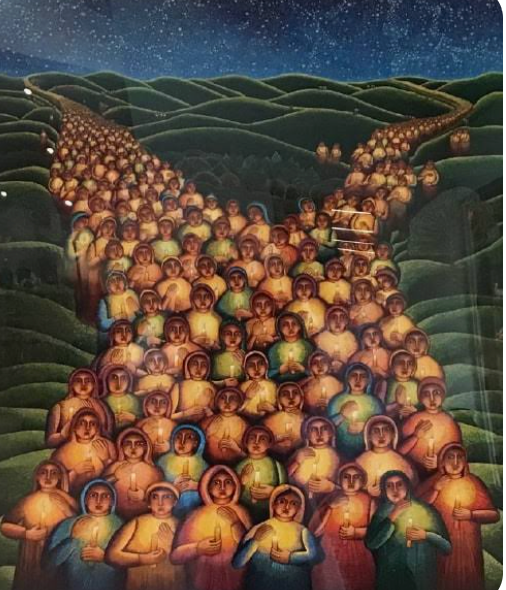
Sainthood or Good Enough?
Holy Spirit take my words and speak to each of us according to our need.
When we think about saints, what sort of people come to mind? It may be people from long ago, with names we struggle to pronounce, whose lives seem impossibly holy. People who spent hours in prayer, gave everything away, cared for the poor, or stood firm in their faith when life became difficult. Or we might think of people closer to home. Someone we have known who seemed to have a particular goodness about them. Someone who was kind, patient, generous, or whose faith quietly carried them through life. Perhaps we think of these people and think, “Well, that's lovely, but I'm not sure I could ever be like that.” We know our own shortcomings, our impatience, the things we wish we had done differently, the times we have failed to love as well as we might. We know the doubts we carry and the days when simply getting through the day feels like enough.
So, sainthood can seem like something reserved for other people. People who are better than us. People who have somehow got life and faith sorted out. But what if we have been looking at the saints in the wrong way?
What if the saints are not people who have got life right, but are the people in whom God has been quietly at work when life has gone wrong? What if sainthood is less about being perfect and more about allowing ourselves to be loved by a God whose grace is always at work, even in the most ordinary and imperfect of lives?
I wonder whether that is what Jesus is trying to show us in the Beatitudes. Because the people Jesus calls blessed are not quite the people we might expect. Blessed are the poor in spirit. Blessed are those who mourn. Blessed are the meek. Blessed are those who hunger and thirst for righteousness.
These are not descriptions of people who have everything together. They are not people who have reached some extraordinary level of spiritual achievement. They are people who know they are in need. People who grieve. People who long for things to be different. People who are struggling, searching, hoping and sometimes just hanging on. And Jesus calls them blessed. He calls them blessed now; he doesn't say they will be blessed if they get their lives sorted out or tell them to come back when they are stronger, happier, more confident or more faithful. Now.
This doesn’t mean that grief is good, or suffering is something we should seek, or injustice is something we should simply put up with. Jesus is not asking us to pretend that painful things are painless. He is telling us something deeper: that none of those things can place us beyond the reach of God's love.
And that changes how we might think about the saints. The saints are not people who have managed to escape the struggles of being human. They are people who have discovered, in all sorts of ways, that God meets us in the midst of our humanity. They are people who have known joy and sorrow, courage and fear, certainty and doubt. People who have sometimes got things wonderfully right and sometimes got things badly wrong. People whose lives, in ways both great and small, have pointed beyond themselves towards the love of God. Because that is what saints do. They point beyond themselves. We sometimes put saints on pedestals, as though the point of their lives were simply to admire them. But rather, the point is to look through their lives, towards seeing the God who loved them, sustained them and called them onwards.
The saints we remember today were also unable to see the whole picture. They lived their lives in the same unfinished world that we inhabit. A world where people get hurt, where relationships break down, where injustice continues, where prayers sometimes seem unanswered, and where death comes to people we love.
They did not always see the fruits of their faithfulness. Some worked for justice without seeing justice prevail. Some offered love without knowing whether it would be received. Some planted seeds of faith whose growth they would never live to see. Yet they kept going. Not because they could guarantee the outcome, but because they trusted in the God whose promises were bigger than what they could see.
And this is where the Beatitudes can offer us such an extraordinary hope. Jesus promises that those who mourn will be comforted. Those who hunger and thirst for righteousness will be filled. The meek will inherit the earth. The pure in heart will see God. These are promises that reach beyond the world as we know it. Because the world is not yet the world God longs for.
We know that. We see it every day. We see it in the suffering of others, in the things that happen in our communities, in the brokenness of our own lives, and in the empty spaces left by people who have died. We live in the gap between what is and what God promises will be. And the saints are people who, in their own ordinary lives, have helped us glimpse what that promised future might look like. A little more kindness. A little more mercy. A little more courage to speak up when something is wrong. A little more willingness to forgive. A little more determination to make room for someone who feels they don't belong. None of these things brings God's kingdom to completion. None of us can make everything right. But each one can be a glimpse of the world God promises.
The saints are not the finished kingdom. They are signs of it. And that matters, because it means that we do not have to be finished people ourselves. Perhaps we sometimes feel that we are not patient enough, not prayerful enough, not generous enough or not faithful enough to be the sort of person God could use. Perhaps we think that if we were a better Christian, we would have fewer doubts, more answers, or a greater sense of God's presence.
But the Beatitudes invite us to see things differently. Jesus blesses those who know their need, those who grieve, those who hunger for something better. He does not wait for them to become perfect before speaking God's blessing over them. God does not love some imagined, improved version of us more than he loves us as we sit here today. God loves us as we are. And His love is not the end of the story but instead where the story begins. There is a saying that ‘God loves us as we are, but He loves us too much to leave us there’ That doesn't mean we should stop trying to grow in faith and love. It means that we grow from a place of being loved, rather than struggling to become worthy of love.
So sainthood begins in some very ordinary places. It begins when we offer kindness even though we are tired. When we admit that we need help. When we try again after getting something wrong. When we sit alongside someone who is grieving without feeling the need to find the right words. When we make room for someone who has been overlooked. Sometimes it begins by allowing someone else to care for us.
These things may not seem particularly remarkable. But they are ways in which God's love takes flesh in the world, through people who are still learning, still growing, still being made new. And on All Saints’ Day, it is especially important to remember that.
For some of us, this year has brought the death of people we love. Their absence may still be raw. Perhaps it seems that the world carries on as usual, while our own world has changed completely. Today does not ask you to put that grief aside. The Beatitudes do not tell those who mourn to stop mourning. They call them blessed. Grief is not a failure of faith. It is often the shape that love takes when someone is no longer here to receive it. We grieve because someone mattered. Because their life was woven into ours. Because we loved them, and because, they loved us. And we do not have to pretend that the person we have lost was perfect in order to give thanks for them. We can remember the goodness they brought into our lives alongside their flaws. We can acknowledge the difficult things, the regrets, the words left unsaid, and we can give thanks for what was beautiful without pretending that everything was easy.
Because the hope of the Christian faith is not that the people we love were perfect. It is that God's love is greater than our imperfections, greater than our failures, and even greater than death. We entrust those we love to the God who made them, who knew them more fully than we ever could, and whose promises reach beyond the limits of our understanding.
The saints we remember today are part of that hope. Their stories are not stories about the past. They are reminders that God's work is not finished. And neither is ours. We may never know the full effect of a kindness we offered, a prayer we prayed, a burden we helped someone carry, or a little act of faithfulness that seemed insignificant at the time. We may never see the end of the story. But we can trust that our lives are held within a story whose ending rests with God.
So, this All Saints’ Day, we can give ourselves permission to stop asking whether we are good enough to be saints and we can ask instead: Where might God's love be quietly at work in my ordinary life? Where might I offer a glimpse of the world God promises? And where might I need to let myself be loved, comforted and carried by others?
We remember the saints not because they were perfect, but because their lives point us towards God, who is faithful. We give thanks for those who have gone before us, for the love they gave and the hope they shared, however imperfectly. We bring our grief, our doubts, our unfinished stories and our ordinary lives before God. And we trust that the God who blessed the poor in spirit, who promised comfort to those who mourn, and who raised Jesus Christ from death, will be faithful to his promises.
For the kingdom is not yet complete. There is still sorrow to be comforted, injustice to be challenged, mercy to be offered and peace to be made. But God's future is coming. And until that day, we are invited to live as people who belong to that future already: loved by God, held by grace, and called to let His kingdom shine through our ordinary lives.
Amen.