
Homilies
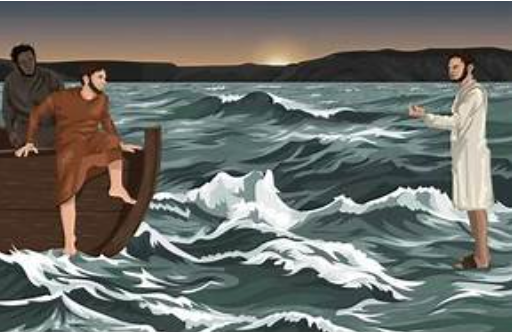
Get out of the Boat
Holy Spirit take my words and speak to each of us according to our needs
There are few moments in the Gospels that feel as human and as vulnerable as the one we have just head about. Peter stepping out of the boat.
For a brief moment, he does something extraordinary. He sees Jesus standing on the water, he hears his word: “Come.” And he climbs over the edge of the boat and begins to walk towards Christ.
Imagine that moment. Being both autistic and ADHD, I can often struggle with imagining myself in the place of someone else or allowing the scene described to become so real that I can imagine myself being there in the midst of it, but this story draws me in, possibly because the quite space at the centre of all the noise feels recognisable.
The wind is blowing. The waves are rising. The storm is loud and deafening. The other disciples are still safely inside the boat. But Peter, in that moment can only hear the quiet, calm, reassuring voice of Jesus, inviting him to come and so he takes a step of faith. All else is forgotten in that moment. Peter’s focus is solely on Jesus.
And then… he falters, he notices the storm. He feels the wind. He looks at the waves. He remembers the impossibility of what he is doing. He loses his focus on Jesus and he begins to sink.
It is easy to criticise Peter. We might think, “Peter, how could you doubt? You were literally walking on water!” But perhaps we should be gentler with him, because Peter’s story reflects our story. Because this is the human condition.
We are people who can see God’s goodness one moment and then be overwhelmed by fear the next. We can know that we are loved by God, and yet still wonder whether we are enough. We can believe in resurrection, and yet still struggle when life feels hard and we mourn our friends in death.
Peter’s problem was not that he lacked faith completely. Peter had enough faith to get out of the boat. His problem was that, just for a moment, he allowed something else to become bigger than Jesus.
And perhaps that is where many of us find ourselves. We are told that we should love God with all our heart, all our soul, with all our mind, and with all our strength. And we try.
We do not lack faith. We are here because, in some way, we trust Christ. We come to worship, we pray, we seek God, we gather as community.
But sometimes the storms FEEL bigger than the Saviour. Sometimes the voices in our own heads become louder than the voice of Christ.
The human mind is an extraordinary gift from God. Our ability to think, imagine, analyse and plan is part of what makes us human. But that same gift can sometimes become a burden.
Our minds can create barriers before we have even begun. “How can I possibly do that?” “What if I fail?” “What will people think?” “I am not good enough.” “I have made too many mistakes.” “I am too old.” “I am too young.” “I am too ordinary.”
The world is full of messages telling us who we should be. We are constantly encouraged to compare ourselves with others, to measure our worth by achievement, appearance, popularity, productivity or success.
And before we know it, we are living not as the people God created us to be, but as people shaped by fear. Peter looked at the waves and forgot about the one who had called him onto the water. The one whom wind and waves obey, the one who created all things. We look at our circumstances and somehow forget the one who walks with us through them.
So how do we overcome this? How do we live fully as human beings, in the world but not of the world? It might surprise you that the answer is not to become less human.
Sometimes Christians have misunderstood holiness as escaping from ordinary life. As if following Jesus means becoming detached from emotions, struggles, doubts and ordinary human experiences.
But Jesus did not come to rescue us from being human. Jesus came to show us what humanity looks like when it is fully alive in God. Jesus laughed. Jesus wept. Jesus ate meals with friends. Jesus knew tiredness, grief, disappointment and pain.
God did not become human reluctantly. God embraced humanity completely in Jesus Christ. So our calling is not to reject our humanity, but to allow Christ to transform it. We are called to be fully human, but with our eyes fixed on God.
Perhaps a helpful image might be that of learning to walk with someone we trust. A child learning to walk, at first, wobbles. They fall. They get back up. They reach towards the person whose arms are open. The child does not think, “I have calculated the exact probability of success, and therefore I will attempt this step.” They simply trust.
Faith is not the absence of fear. Faith is taking the next step while fear is still present. Peter did not walk because he was fearless. He walked because Jesus said, “Come.”
And when Peter began to sink, notice what Jesus did. Jesus did not say, “Peter, you foolish man. You should have known better.” Jesus reached out his hand.
That is one of the most beautiful images in Scripture. When Peter’s faith failed, Christ’s faithfulness did not. When Peter lost sight of Jesus, Jesus never lost sight of Peter. He continued to reach out to him.
And that is true for us. Our relationship with God does not depend on our ability to hold on perfectly. It depends on Christ holding on to us and us learning to accept it.
But how do we practically keep our eyes on Christ in a world that constantly pulls our attention away? Perhaps we begin with small acts of remembrance. Because we often do not lose faith in one dramatic moment. More often, we drift slowly.
We become so busy that prayer disappears. We become so overwhelmed by bad news that hope becomes difficult. We become so focused on what is wrong that we forget what is good.
So we need practices that turn our hearts back towards God. A moment of gratitude each day. A prayer before we begin work. A pause to notice beauty. A conversation with someone who reminds us of God’s love. Reading Scripture not simply to gather information, but to encounter Christ.
These things may seem small, but small acts of faithfulness shape us. They help us recognise the voice of Jesus above the noise of the storm.
And let’s not forget that we need one another too. Peter was not alone in the boat. The Christian life was never designed to be lived in isolation.
There are times when our own faith feels weak, and that is when we borrow faith from others. Sometimes another person sees God’s hope for us when we cannot see it ourselves. Sometimes someone else reminds us: “You are loved.” “You are not alone.” “God is still at work.”
Community matters because storms are easier to face together. The church is not a gathering of people who have everything sorted. The church is a boat full of people who are learning to trust Jesus.
People who sometimes step out boldly, sometimes panic and sometimes sink. But people who are held by grace.
Perhaps the most important thing we can learn about ourselves from Peter’s story is this: Jesus did not call Peter because Peter was already perfect. Jesus called Peter knowing Peter would doubt. Knowing Peter would misunderstand. Knowing Peter would fail. And still Jesus said, “Come.”
Christ does not wait until we have conquered every fear before inviting us into his work. He does not wait until we are confident enough, clever enough, strong enough or holy enough. He calls ordinary people, with ordinary struggles, into extraordinary trust.
So when we hear those words: “You of little faith, why did you doubt?” Perhaps we should not hear them as words of condemnation. Perhaps we should hear them as the gentle question of a loving Saviour. “What made you look away?”
“What made the storm seem bigger than me?” “What made you forget that I am here?”
Because the answer is not found in trying harder or becoming stronger through our own efforts. The answer is found in turning our eyes back to Christ. The storms will still come. The waves will still rise. There will still be moments when our minds create barriers and fear whispers louder than faith.
But Jesus remains. The one who walks upon the waters. The one who reaches out his hand. The one who says again and again: “Do not be afraid.” “Take courage.” “It is I.” “Come.”