
Creative Writing
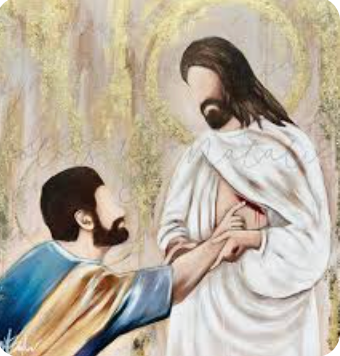
Doubting Thomas
Holy Spirit take my words and speak to each of us according to our needs.
I wonder how many of us have ever been called by a name we didn’t quite choose for ourselves. It tends to stick, doesn’t it? At school, I was often called Squidge as my surname was Squire, or later on I’ve been known as Lea. For Thomas the Apostle, it’s “Doubting Thomas.” And perhaps unfortunately, that’s how he’s been remembered ever since. But I’m not sure it’s entirely fair. Because if we’re honest, Thomas is perhaps the most relatable of all the disciples. He says out loud what many people may have felt quietly: “I’m not sure I can believe this unless I experience it for myself.”
And that sounds remarkably like the world we live in today. We are living in an age of uncertainty. We are surrounded by information, but not always by clarity. We hear conflicting voices, on the news, on social media, even within our own communities and friendship groups. Questions about truth, trust, and meaning are everywhere. And for many people, faith is not something that is rejected outright, rather it’s something they’re simply unsure about.
So when Thomas says, “Unless I see… I will not believe,” he’s not being awkward or difficult. He’s just being honest. And honesty, in the life of faith, is actually a very good place to begin. Let’s remind ourselves of that moment which Thomas was part of. The risen Jesus had already appeared to the other disciples. They were full of excitement and conviction: “We have seen the Lord!” they said, but Thomas wasn’t there.
And when they tell him, he cannot quite accept it second-hand. He wants something real. Something personal. Something he can encounter for himself. And then, Jesus comes again. A week later. And this time, Thomas is there.
And most notably, what does Jesus do? He does not rebuke him. He does not shame him. He does not say, “Why didn’t you believe your friends?” Instead, he says: “Put your finger here. See my hands. Reach out your hand and put it in my side. Do not doubt but believe.”
In other words: “Thomas, I meet you exactly where you are.”
And that, I think, is the first thing this Gospel offers us today. Christ meets us where we are—not where we think we ought to be. And that matters enormously. Why? Because many people carry a quiet sense that they are somehow “not good enough” for faith. Not certain enough. Not holy enough. Not convinced enough. But Thomas shows us that doubt is not a barrier to Christ, it can be the very place where Christ meets us. We see something similar in our wider society. In recent years, there’s been a growing openness around mental health. People are beginning to say, more honestly, “I’m struggling,” or “I’m not okay.” And that honesty, difficult though it is, has opened the door for support, for connection and healing.
In the same way, when we bring our doubts into the light, be that into prayer or into conversation, we make space for God to meet us there.
So perhaps one gentle invitation this week might be to be honest with God; To name one question, one uncertainty, one area of struggle and to wait and trust that Christ will meet us in that place.
But Thomas’ story doesn’t end with doubt. Because when Thomas encounters Jesus, everything changes. He doesn’t simply say, “Oh, now I understand.” He says something far deeper: “My Lord and my God!”
This is not just an intellectual agreement. This is relational, it is a relationship. It is recognition and this is worship.
And that’s where we can find our second lesson: Faith is not just about having the right answers—it is about knowing the living Christ.
That’s important in a world like ours, where so much emphasis is placed on information. We are used to unconsciously analysing, comparing and verifying. And those are good and valuable skills. But faith is not simply about assembling evidence. It is about encounter.
As Anglicans, in the Church in Wales, we are given numerous beautiful ways to nurture that encounter: through Scripture, in prayer, in the sacraments, in the quiet rhythms of worship. Week by week, we gather not just to think about God, but to meet with God. The whole shape and form of the liturgical year is designed to help us meet with God and be part of His story and that meeting, whether quiet or profound, is what shapes our faith over time.
Jesus then says something that reaches out across the centuries to us: “Blessed are those who have not seen and yet have come to believe.” That is us.
We were not in that upper room. We have not touched those wounds. And yet we are called blessed; not because our faith is easier, but because it is lived in trust. And trust, as we know, is not always easy.
We live in a time when our trust has been tested. Trust in institutions has been shaken. Be that in politics, media, or public life. Many people are left wondering and asking, “Who can I believe? What is true?”
Add to that the rise of new technologies, where images and words can be generated artificially, and the question becomes even more pressing: What is real? Children at school are now being taught how to identify fake news, AI content and images and to question what is presented to them rather than accepting it at face value.
Into that uncertainty, the Christian faith speaks a quiet but radical truth: that truth is not just an idea but rather it is a person; Jesus Christ. And to trust him is not to casually switch off our minds, but to anchor our lives in something deeper than changing opinion.
Now, there’s also something else worth noticing about Thomas. He does not remain “the doubter.” Tradition tells us that he went on to carry the Gospel far beyond the familiar world of the other disciples. Quite possibly, even as far as India.
And so, the one who doubted became the one who proclaimed. Which leads us to another important truth: Our doubts do not disqualify us from being used by God.
In fact, they may even deepen our abilities to share God’s love with others. Because in today’s world, authenticity matters. People are more often than not becoming wary of anything that feels too perfect or too certain.
But when someone says, “I have wrestled with questions and I have found Christ faithful,” that carries weight. Even if only in its sincerity to begin with.
The Church is not called to present a façade of perfection. We, as Christians, are called to bear witness to grace from the God who meets us and shapes us, and then sends us out to tell others.
So what difference does being a Christian make in all of this? Let me, if I may, suggest three simple things.
Firstly, it gives us hope. Not a vague optimism, but a hope grounded in the resurrection. Thomas saw that the one who was crucified was now alive and that means that suffering and death do not have the final word.
Secondly, it gives us community. Thomas was not left alone. He was brought back into the fellowship of the disciples. And in a time when loneliness is increasingly recognised as a serious challenge in our society, the Church is called to be and should be a place of belonging, welcome and of shared life.
Thirdly, it gives us purpose. We are sent into the world, not with all the answers, but with the presence of Christ dwelling within us. In our workplaces, our families and our communities, we are called to live out that faith in practical, ordinary yet visible ways.
So how might this have an impact our lives this week?
Perhaps it means making space for honest, unsanitised prayer. Allowing ourselves to bring our real selves before God.
Perhaps it means reaching out to someone who may be feeling isolated and offering them a word, a visit or a listening ear. Maybe even just note through the door, flowers on their doorstep or treat perhaps. (if anyone is wondering, I love muffins )
Perhaps it means sharing something of our own journey of faith. Not as a polished, finished story, but as a living one, ongoing and changing. Show integrity and honesty with your experiences of times of euphoria as well as those where it was difficult.
Or perhaps it means showing up for yourself first, rather than someone else. Coming to worship, to pray, and to receive, trusting that Christ meets us here.
The risen Jesus still comes to his people. He comes into our locked rooms, containing our fears, our doubts and our uncertainties and he speaks the same words: “Peace be with you.” “Do not let your hearts be troubled, neither let them be afraid” And then, just as he did with Thomas, he gently, invites us further to: Come and see. Come and trust. Come and believe.
And as we do, may we find ourselves, like Thomas, saying not only with our lips but with our lives: “My Lord and my God.”
Amen.