
Homilies
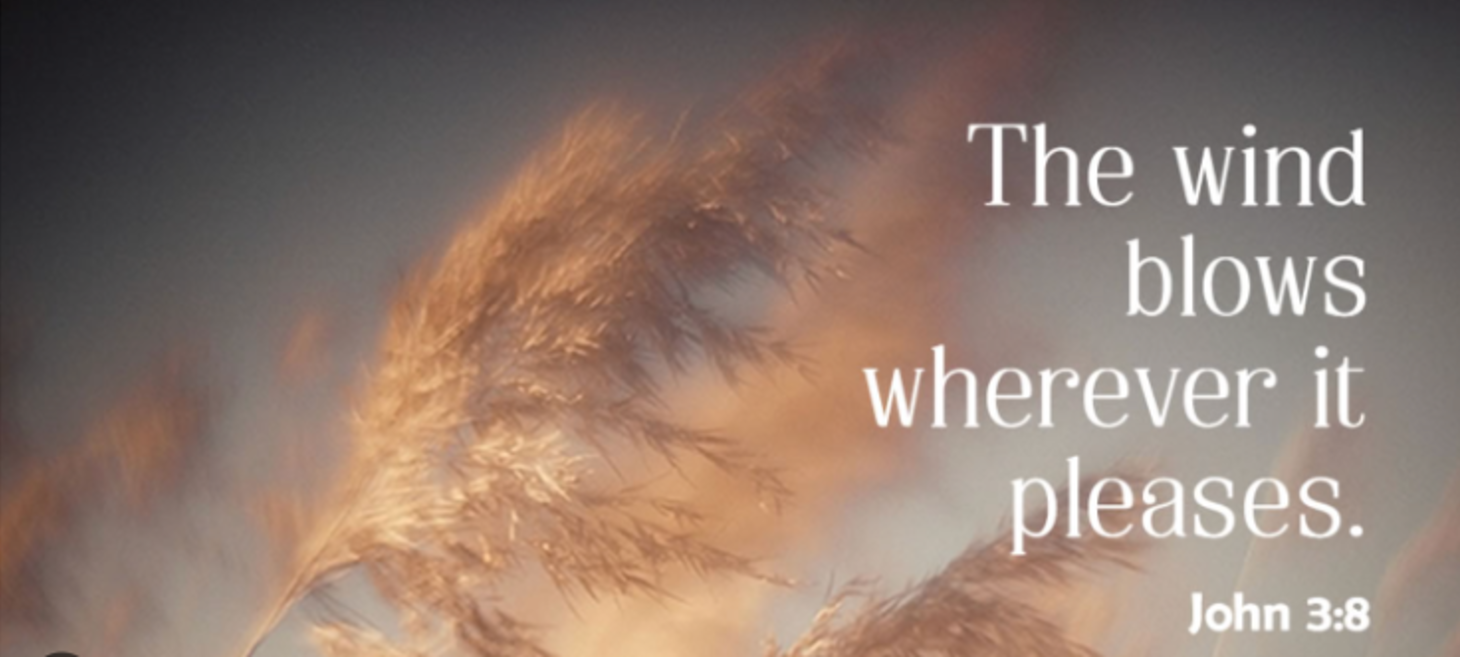
Born of the Spirit
May I speak in the name of the living God, who breathes life into all creation, who meets us where we are, and who gently calls us into who we are becoming. Amen.
There’s something wonderfully mysterious about wind. You can’t see it. You can’t hold it. You can’t predict exactly where it will go next. And yet, you know it’s there. You feel it on your face when you step outside. You hear it in the trees. You see it ripple across a field or stir the surface of water. Wind is invisible, but its presence is undeniable because of its effects are seen.
Jesus used that very image to help Nicodemus understand what it means to be alive in God. He said, “The wind blows where it chooses, and you hear the sound of it, but you do not know where it comes from or where it goes. So it is with everyone who is born of the Spirit.”
Those words were spoken during a quiet nighttime conversation. Nicodemus, a respected, prominent, religious leader had come to Jesus with questions. He was thoughtful and curious. He sincerely wanted to understand. And Jesus, instead of giving him a neat formula or a theological diagram, gave him a metaphor; the wind.
That tells us something straight away: faith is not simply something we figure out; it is something we experience. It’s not only about certainty; it’s about encounter. It’s not only about doctrine; it’s about transformation. Nicodemus was well versed in certainties and doctrines but something wasn’t quite right.
There was a deeper question beneath the question that Nicodemus presented to Jesus. The man who came to Jesus that night wasn’t just asking about theology. Beneath his words was a deeper question, Who am I really? And perhaps: Can I become someone new?
Jesus’ answer points toward a truth that sits at the heart of Christian life. Our identity is not fixed by our past, our mistakes, our labels, or even our own or others’ expectations of ourselves. Our truest identity is something given by God, something breathed into us by the Spirit. And like the wind, that Spirit moves freely. It isn’t boxed in by our labels or controlled by our plans. It isn’t limited in any way by anything that we can do or what we think is possible.
Being influenced by something outside of our understanding or control can feel unsettling. It is in our nature to prefer certainty with firm boundaries and predictable outcomes. Yet Jesus invites us into something more than certainty; into trust.
The way Jesus describes the Spirit, shows its freedom, but that is not to say it is disordered of chaotic. Chaos is meaningless motion. Freedom is purposeful movement that we may not fully understand. The wind that sweeps across the hills is not disordered; it is simply larger than our ability to grasp it.
In the same way, God’s Spirit is always at work, sometimes quietly, sometimes dramatically, and often in places we least expect. The Spirit may stir courage in someone who has always felt afraid. The Spirit may plant compassion in a heart that once felt closed. The Spirit may awaken hope where despair once settled in. And Jesus says this is true of everyone born of the Spirit. Not just the people who seem to have it all together. But everyone.
We may have heard Grace being spoken about as something that comes before we even know to ask for it. God is already at work in us long before we realise it. The Spirit is already breathing life into us long before we learn the language of faith. So, for Nicodemus and for those of us with doubts and questions today, discovering our identity in Christ is less like building something from scratch and more like uncovering something that has always been there.
Like a seed that already contains the shape of the tree it will become. The life is hidden inside. The potential is real even before it is visible. If we get the conditions are right, growth happens. The Spirit is like that within us. We don’t earn it or force it. But when the conditions are right, we notice it and receive it.
And just as no two trees grow in exactly the same way, no two journeys of faith look identical either. Some lives unfold slowly and steadily. Others change direction suddenly. Some people experience faith like a quiet dawn. Others like a burst of sunlight through clouds. So, if the Spirit moves like the wind, then we don’t have to compare our spiritual lives to anyone else’s. The wind does not blow the same way in every place. And the Spirit does not form every soul in the same pattern.
Our walk with God is allowed to be our own. Just as Nicodemus was prepared to be changed after so long.
For some, faith is full of questions. For others, it feels steady and assured. For some, it’s a lifelong unfolding. For others, it comes in turning points. None of these are more “real” or ‘right’ than the others. What we need to be mindful of is not how the wind moves, but that it is moving.
So if the Spirit is like the wind, then how do we notice it? Well, we notice it in the same way we notice wind itself; by its effects.
Sometimes the Spirit’s movement feels like restlessness, a gentle nudge that something in your life wants to grow or change. Sometimes it feels like peace, a deep sense that, even in uncertainty, you are held. Sometimes it feels like conviction, a clear invitation to step into an altered way of living.
The Spirit’s voice may be just like the wind, pushing against a door until it opens; persistent, and steady, and perhaps sometimes blustery and urgent.
Where might we see love growing in our lives where it wasn’t before? Where might we notice patience, kindness, or courage appearing unexpectedly? Where might we find ourselves drawn toward compassion, justice, or reconciliation? – If we can notice these things in our lives, it may be the spirit moving.
So how might we live in response to Jesus words to Nicodemus?
Firstly, we can practice openness. If the Spirit moves freely, then our role is not to control it but to welcome it. A simple prayer “Spirit of God, guide me today” can be an act of openness. We may not know where that prayer will lead, but we can trust that God does.
Secondly, we can release the need for perfection. Just as the wind does not wait for a landscape to be flawless before it blows. God does not wait for us to be perfect before working in us. Transformation often happens in the middle of ordinary, imperfect, everyday life.
Thirdly, we can honour the Spirit in one another. If the Spirit moves uniquely in each person, then every individual we meet carries a story of God’s work.
And lastly, we can trust the process. Wind shapes landscapes slowly. It carves rock, carries seeds and forms dunes but not in an instant, rather, gradually over time. Our growth may be gradual. Change may be subtle. But subtle does not mean insignificant.
Sometimes, there may be times when we don’t feel the wind at all. Times when prayer feels dry or difficult, when faith feels distant or even absent and when God seems to be silent. But Jesus’ words still hold in those seasons. The wind may be invisible, but it has not ceased to exist. In the same way, the Spirit’s presence is not dependent on our awareness of it. God’s life in us does not switch off when our emotions fluctuate.
Faith, then, is sometimes less about feeling the wind and more about trusting it is still blowing.
Jesus did not speak to Nicodemus about the wind merely to explain something. He spoke as an invitation. He invited Nicodemus and he invites us to step into a life shaped not by fear of failure, but by Spirit.
To be “born of the Spirit” is to discover that our identity is not something we must anxiously construct. It is something we receive with gratitude when we notice that it has always been there. We are people breathed into life by God. People carried, shaped, and renewed by a love we may not always have known, one we cannot control but one that we can always trust.
This is especially good news, for those of us who have ever wondered if we belong, if we are enough or even too much at times, or if our story even matters.
I’d like to leave you with a challenge for when you leave here today, perhaps you could pay attention to the wind, literal or spiritual. Notice where you sense movement, stirring, invitation. Notice what feels alive.
You don’t have to chase the wind. You simply have to stand and be open to it. Because the Spirit of God is already moving in this place, in this moment, and in us all.
Amen.