
Homilies
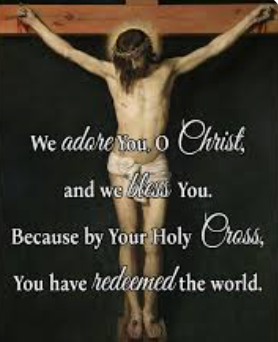
When the Curse becomes the Cure
Holy Spirit, take my words and speak to each of us according to our need
Today, as a church we keep Holy Cross Sunday, a feast that calls us to look directly at the Cross of Jesus Christ and what it means. The Cross is not something we would naturally celebrate. It was a brutal Roman instrument of torture, designed to humiliate and destroy. And yet, the Church dares to set aside a day not to look away, but to look more closely. Because at the Cross, God transformed what was meant as a punishment or curse into the greatest cure.
To help us explore what that means, our readings take us all the way back into the Old Testament, to the wilderness in the time of Moses.
The people of Israel had been freed from slavery, but their freedom wasn’t always easy. The wilderness was harsh. Their faith was fragile. And they grumbled. They doubted God’s care and rejected his provision and some longed to return to the security of slavery.
This might be something that we can identify with ourselves. We might not be wandering through Sanai or the wilderness, but we can recognise how easy it is for our patience to run thin or for our words to turn bitter, for us to fall back into old habits, and for us to mistrust the very God who has never let us go. It’s that innate human tendency to make wrong choices, even when we know better.
In Israel’s case, the consequences were terrifying: venomous serpents were released throughout the camp. The people cried out in fear, they were dying and so God provided a remedy. He told Moses to make a bronze serpent, lift it on a pole, and all who looked upon it would live. The very image of the curse, the serpent, became the channel of healing.
Already here, we can see God’s way of working: not sweeping away the problem but transforming it in front of the people into a place of mercy. God didn’t ask them for anything, he didn’t tell them to fight the serpents or to use them to brew healing potions. In fact, they didn’t have to do anything to be healed, except look and trust. In this way, healing was available to everyone, not dependent on wealth, status, ability or power.
This image of the serpent lifted up has since been seen across numerous traditions throughout the world. Across cultures, the serpent came to represent both danger and healing; a paradox of harmful venom but also providing a healing antidote. In Greece, there was the rod of Asclepius, one serpent wound around a staff, became the symbol of medicine. Also, the Caduceus, the symbol of two serpents wrapped around the staff of Hermes. Even today, it can be seen on ambulances, in hospitals, and in doctors’ surgeries.
It’s significant that healing through to modern medicine has always been seen as both facing the poison and transforming it. And that is exactly what Moses’ serpent taught in his time, and it’s exactly what the Cross teaches us now.
Here in Wales, we have our own story of healing made available for all. Aneurin “Nye” Bevan, the son of a miner from Tredegar, believed that healthcare should not be a privilege for the wealthy but a right for everyone. Out of that conviction came the NHS in 1948. It’s worth pausing on this Holy Cross Sunday to give thanks for that vision, and for the countless nurses, doctors, and carers who live it out. For them too, the serpent lifted high has become a symbol, through the Hippocratic oath, and a reminder that healing is meant to be shared not earned.
But the wilderness serpent is not just a quaint story, nor for today, merely a medical emblem. It is, as Jesus himself says, a foreshadowing of the Cross.
In John’s Gospel we hear: “Just as Moses lifted up the serpent in the wilderness, so must the Son of Man be lifted up, that whoever believes in him may have eternal life.”
What could this mean? It means that in Jesus, God has taken on the full weight of humanity’s wrong choices. All our violence, our betrayals, our selfishness, our ungratefulness and our failures and he bears them on the Cross. The very things that poison and taint our lives, he takes upon himself.
And astonishingly he doesn’t destroy them by sheer force. He transforms them, through his own death and resurrection. The Cross, an instrument of death, becomes the sign of life. The curse becomes the cure.
So what does this mean for us, here, in South Wales in 2025? It means, firstly, that we are not abandoned in our wilderness moments. That might be those times in the wilderness of ill health. Sometimes the wilderness of loneliness in a small community where young people move away. Sometimes the wilderness of economic struggles of our valleys and towns. And sometimes the wilderness is in our hearts: regret, disappointment, or the memory of choices we wish we hadn’t made.
The transformation by the Cross says: you are not alone there. God has entered into the wilderness with you.
It means, secondly, that the cure is always within reach, if we choose to reach out. Just as the Israelites needed only to look up at the bronze serpent, so we are invited to lift our eyes to Christ. It doesn’t mean that every problem vanishes overnight. But it does mean that there is healing available deeper than any wound, and a hope stronger than any despair.
It means, thirdly, that we are called to be a people of healing ourselves. If the Cross is where the curse becomes transformed to a cure, then as followers of the Crucified One, our calling is to live that out in our town, in our families, in our communities. We cannot heal every illness, but we can bring kindness where there is bitterness, reconciliation where there is division and generosity where there is need. Each small act is a sharing in the Cross, a lifting up of the possibility of life where before there was only venom.
So today, the invitation is simple but profound: lift up your eyes.
Lift up your eyes from the ground where the serpents slither, from the endless cycle of complaints and bitterness. Lift up your eyes from the news headlines that can make us despair. Lift up your eyes from your own regrets.
Psalm 121 says ‘I lift my eyes to the hills’ and then asks ‘Where does my help come from?’
Think of the hills that surround our town. When you climb up high, the view changes. You can see more than just the road in front of you; you glimpse the bigger picture. In the same way, when we lift our eyes to the Cross, our perspective shifts. We are reminded that our struggles are real, but they are not the whole story. There is something greater, something higher, something that gives hope.
So look instead to the Cross, the place where God has turned the world upside down, where the poison is drained of its power, where death is defeated and transformed, and where love is poured out without measure.
And then, having looked, let us live as people marked by the Cross: not afraid of the wilderness, not paralysed by our wrong choices, but trusting in the God who can take even the darkest curse and transform it into a cure.
Today, Holy Cross Sunday should remind us of the heart of our faith. Healing is not just for the few, it is for all. Hope is not just for the saints, it is for each of us. And the Cross is not only a memory of long ago, it is the transformative power of God for us and with us today.
The serpent in the wilderness anticipated it. Aneurin Bevan glimpsed something of its spirit in the NHS. But only in Jesus, lifted high, do we find the fullness of it: the curse becomes the cure, and the whole world is invited to look and live.
Amen.